

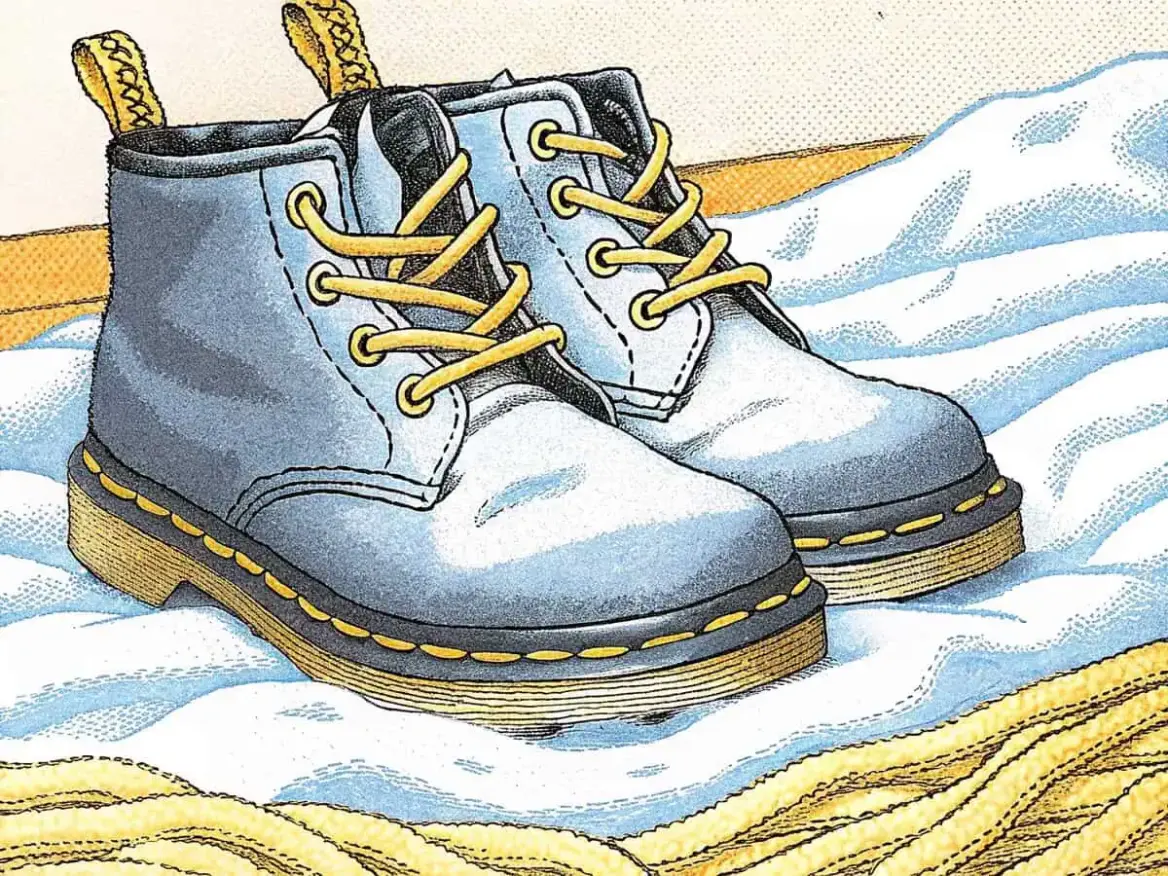
The Benelux Court of Justice declared the trademark registration of the yellow stitching on all Dr Martens shoes invalid because it would have been underused on light lace-up boots and therefore would not be a distinctive sign on those light lace-up boots. What does this mean for trademark protection.
On 6 February 2024, the Benelux Court of Justice ruled in a case between Van Haren Schoenen and Airwair International Limited, the trademark owner marketing the Dr Martens shoes. The question: may Airwair require Van Haren not to market shoes with similar stitching?
Airwair had registered this stitching as a trademark with the Benelux Office for Intellectual Property (BBIE) for all lace-up boots, i.e. regardless of colour.
Van Haren defended its position, arguing that:
- the stitching had no distinctiveness,
- the stitching would have a technical function,
- stitching would add substantial value to the products and thus hamper competition.
The BOIP rejected these objections and upheld the trademark registration. Van Haren then appealed to the Benelux Court of Justice, the highest court within the Benelux for trademark matters.
The ruling: cancellation mark
The Benelux Court of Justice concluded that the yellow stitching did have distinctive character, but only for dark shoes. For light or brightly coloured shoes, the stitching would not be sufficiently distinctive because these variants had hardly been marketed.
The result: the court declared the entire trademark registration invalid. The reasoning was that if the stitching is not distinctive for all lace-up boots, it cannot count as a trademark for the entire product category. Airwair lost the case and was ordered to pay the litigation costs.
The bigger legal picture
The Benelux Court of Justice is the highest court within Benelux for trademark law, but this is not the end of the story. The Court of Justice of the European Union has the final word on the interpretation of regulations such as the Trade Mark Directive.
Good Law: this is a risky development for brands
Good Law finds the ruling worrying; the ruling seems to have created an unjustified stretching of the test for trademark registration.
Under Good Law, a mark should be assessed on the feature applied for itself, in this case the yellow stitching on the sole edge, and not on the specific colouring of the shoes – especially since the latter is explicitly not part of the registration.
We think this is an unnecessary limitation of trademark protection.
If the ruling stands, it means brands will be judged more strictly on how widely they use their brand. This could lead to:
- Additional burden of proof for trademark owners: they have to prove that their mark is recognised on all possible product variants.
- More difficult enforcement: competitors can challenge trademarks if they have not been used in all variants.
Good Law stresses that how the case ultimately ends will have great significance for the future of trademark law.
To be continued!