If you are an entrepreneur and want to protect a unique shape, trademark law may be the first thing that comes to mind.
In practice, however, you will quickly encounter strict requirements and restrictions that apply under the European Trademark Regulation (EUTMR). For example, Article 4(a) of the EUTMR stipulates that a sign, such as a shape, color, or pattern, can only be protected if it has sufficient distinctive character. In addition, Article 7(1)(e) EUTMR excludes shapes that are purely technical or derive their main appeal from aesthetic value. When registering a trademark, therefore, strict checks are carried out on distinctiveness, descriptiveness, conflicting older trademarks, and possible misleading of the public.
Fortunately, there is a more accessible alternative for protecting shapes and designs: design rights. Design rights are subject to considerably less stringent requirements:
- There is no prior assessment of distinctiveness. It is sufficient that the design is new and has its own overall impression (Art. 4(1) Regulation (EC) No. 6/2002).
- Technical aspects may be present, as long as the design is not exclusively technical (Art. 8(1)).
- There is no obligation to use the design; registration (Art. 12) or first publication (Art. 11(1)) is sufficient to obtain protection.
These flexible requirements allow entrepreneurs to quickly and relatively easily obtain exclusivity for the (aesthetic elements of) their designs, without the burden of proof and a number of restrictions that apply to trademarks.
Copyright arises automatically when a design is created that bears the creator’s own original (personal) stamp. In principle, therefore, an original creation would also be protected by copyright. However, precisely because it is not a registered right, the scope of the copyright protection or its starting date is sometimes difficult to prove in practice.
Design rights are a good alternative or supplement to copyright: a design does not have to be very original, and it is clearly registered by someone on a specific date.
What is design right?
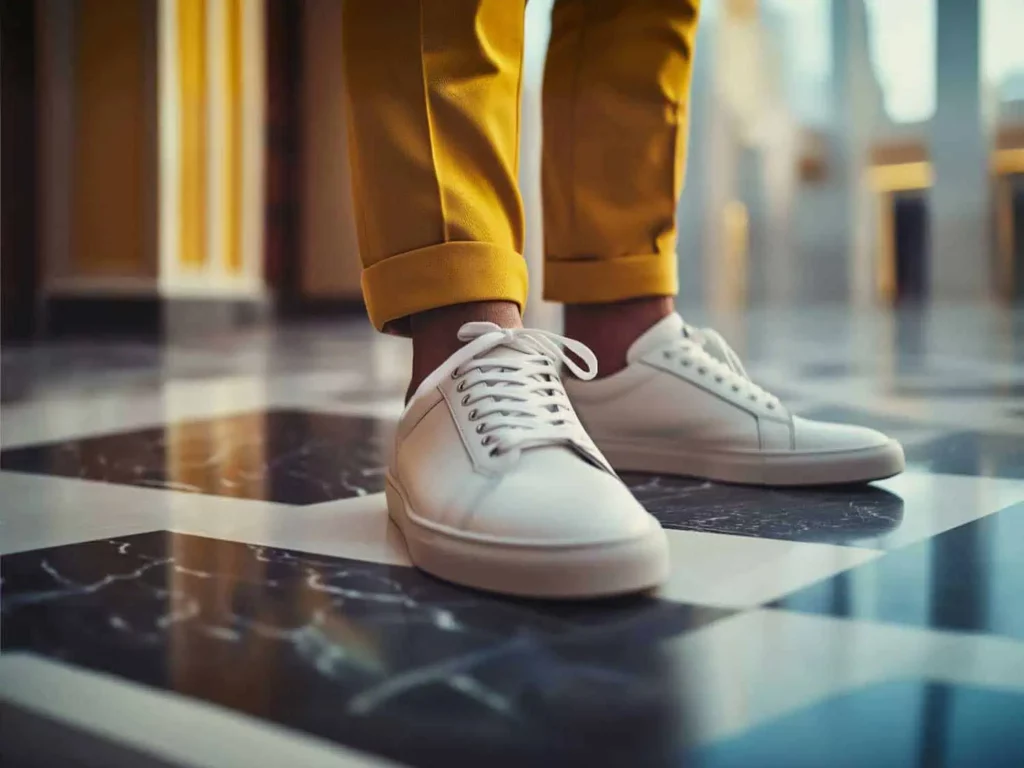
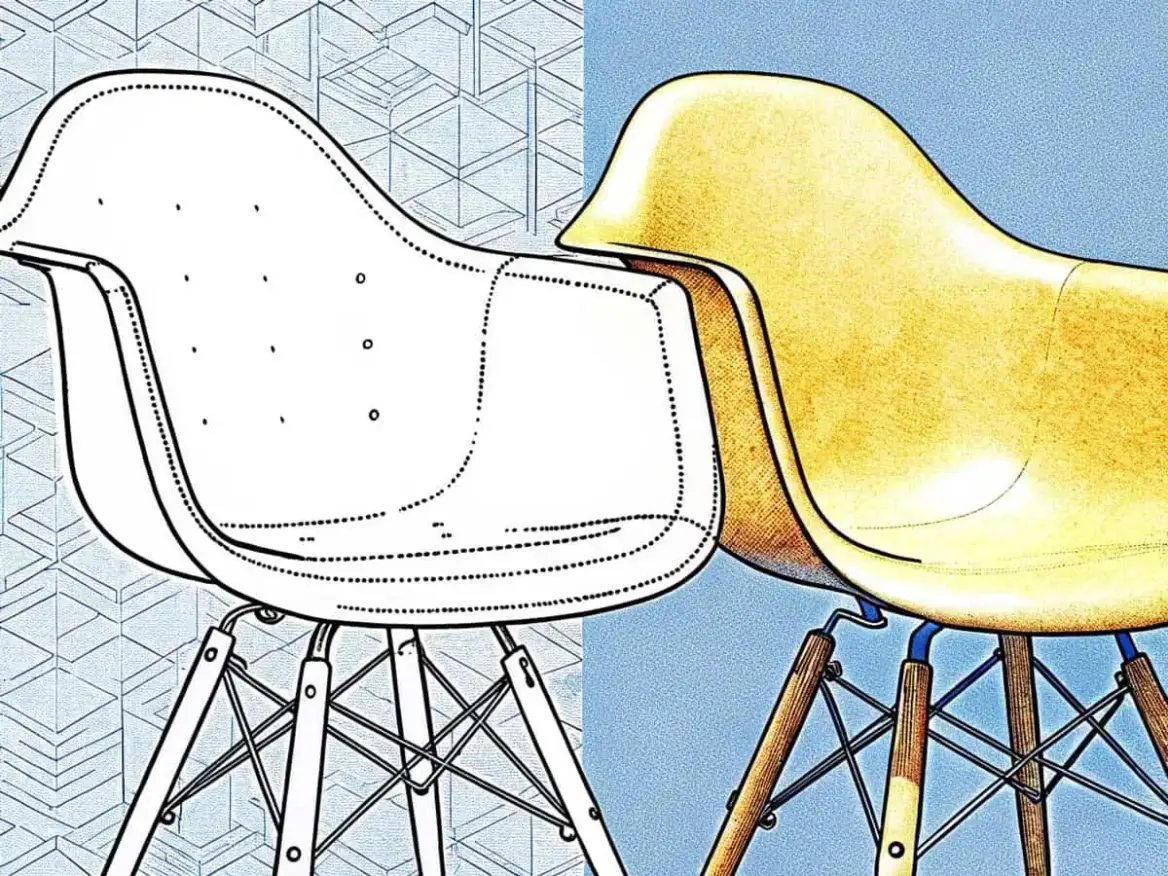
Design rights protect the appearance (design) of products, such as shapes, colors, lines, and textures, provided that this appearance is new and has its own overall impression. The design may not have been known before (only the right holder himself has a grace period of one year, during which he can decide whether or not to file a design application), and must give a different impression than existing designs. Technical aspects are excluded; these are covered by patent protection. A design can be either two- or three-dimensional: for example, the design of a shoe or chair (3D), or patterns on a sole or textile (2D). Combinations of both are also possible, such as a pattern on a bag. Think, for example, of the design of the Apple Watch or the shape of the original Coca-Cola bottle. It is possible to register the entire product as a design. However, this does not monopolize the technical elements. It is also possible to indicate a part in dotted lines. In general, this means that no protection is claimed for this part.
Registering your design in the EU or Benelux
Within the EU, there are two ways to obtain design protection: the registered EU design and the unregistered EU design. You can obtain a registered EU design by submitting a one-time application to the EUIPO, after which your design will be protected in all EU countries for periods of 5 years up to a maximum of 25 years, if the design is approved by the EUIPO. The EUIPO examines the design on absolute grounds such as novelty and individual character.
An unregistered EU design is automatically obtained for designs that are eligible for protection from the moment of first publication (in the European Union). The latter may apply in combination with a registered EU design, but only applies for 3 years and only to copies of the design. The unregistered EU design was created for industries where trends follow each other in rapid succession, such as the fashion industry. In this industry, it is not feasible to file a design for every new model.
The Union design is contrasted with the Benelux design, which only offers protection in Belgium, the Netherlands, and Luxembourg through registration with the Benelux Office for Intellectual Property (BOIP). This design right also provides protection in terms of 5 years up to a maximum of 25 years and must meet the same requirements.
Conclusion
Design rights are an excellent alternative if you cannot protect your design through trademark rights. In many cases, design rights also offer a valuable addition to copyright. They provide a practical and relatively accessible way to secure your designs quickly and effectively.