

Trademark law protects signs that help a company distinguish its products or services from those of its competitors. However, strict conditions apply.
For example, Article 7(1)(e) of Regulation No. 40/94 (EUTMR) stipulates that shapes or other product characteristics cannot be trademarks if they are exclusively (i) determined by the nature of the goods, (ii) necessary to obtain a technical result, or (iii) give substantial value to the goods.
The ground for refusal under Article 7(1)(e)(ii) EUTMR only applies if all the essential characteristics of a shape are necessary to obtain a technical result. If there is an important non-functional element (e.g., a decorative or fanciful element) that constitutes an essential feature without being technically necessary, the ground for refusal of registration of the trademark does not apply.
Registration is therefore only refused for shapes that exclusively contain a technical solution, because in that case a trademark registration would unlawfully restrict the use of that solution by other companies. Without this restriction, the trademark owner would be able to prohibit not only identical shapes, but also similar shapes that fulfill the same technical function.
This principle is not new. In the rulings on the Lego figure , it was already ruled that the registration of any shape must be refused if the essential characteristics consist exclusively of the shape of the product that is technically the cause of and sufficient for achieving the intended technical result, even if that same result can be achieved through other shapes or solutions.
The case: the Rubik’s Cube
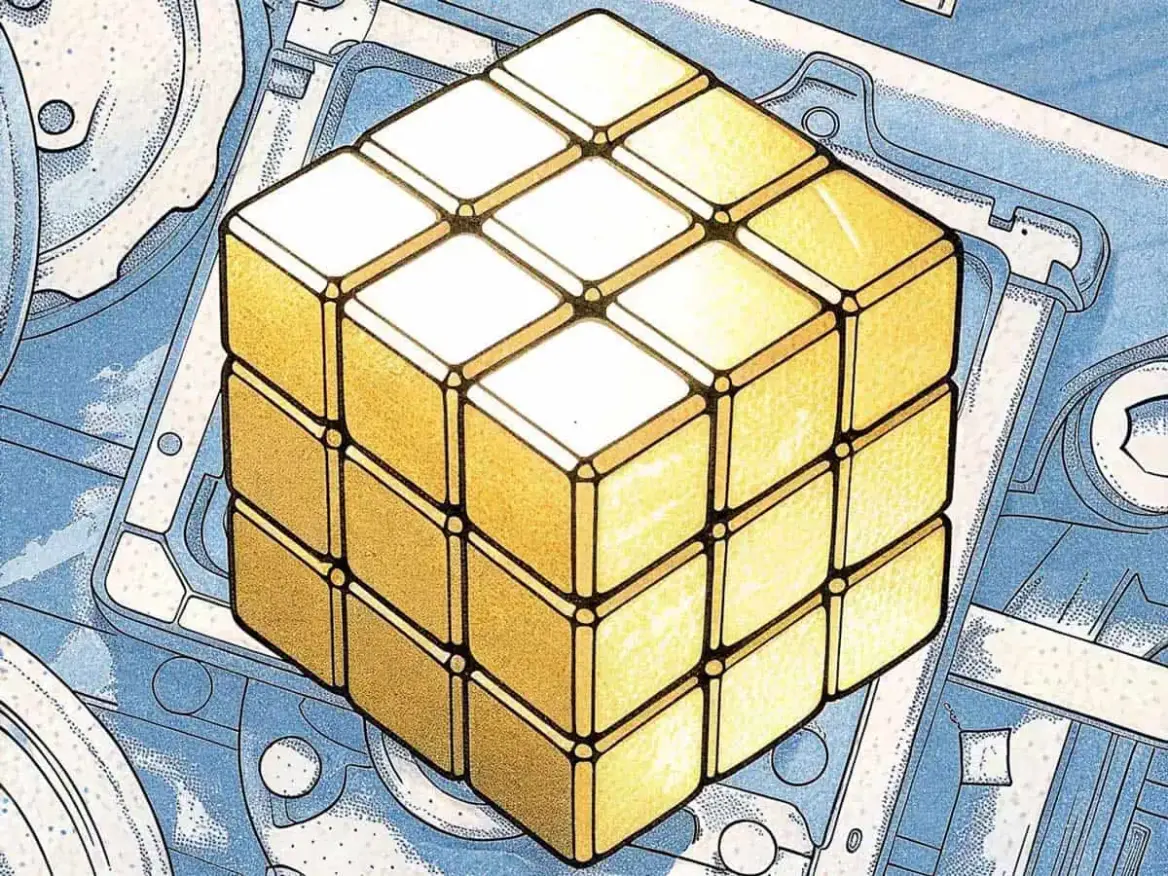
On July 9, 2025, the General Court of the European Union reaffirmed how strictly these requirements are applied in proceedings concerning the three-dimensional EU trademark of Spin Master Toys UK Ltd, which is strongly reminiscent of the well-known Rubik’s Cube. It concerned a cube with a grid structure, each face consisting of nine smaller squares. Verdes Innovations SA, the legal successor to the inventor of the Rubik’s Cube, had requested the EUIPO to invalidate this trademark.
The key question was whether this specific design could be registered as a trademark by Spin Master Toys UK Ltd, or whether it was too closely linked to the technical functioning of the puzzle. The EUIPO declared the trademark invalid, after which Spin Master Toys UK Ltd appealed to the General Court of the EU.
The General Court of the EU ruled that the trademark consisted of three essential features: the cube shape, a grid structure with small blocks (3×3 per side), and six different colors on the sides to distinguish the blocks from each other. The Court ruled that all these features are functional because the shape, grid structure, and colors are necessary for the puzzle to rotate and be solved. According to the Court, the fact that these are “basic colors” and that there are alternative color choices does not alter this. Since all the features are necessary for the functioning of the product, the trademark falls under the grounds for exclusion in Article 7(1)(e)(ii) of the EUTMR.
Why this is important
The ruling makes it clear that trademark protection is not unlimited. A manufacturer cannot use trademark law to establish a perpetual monopoly on technical features. If the Rubik’s cube were protected as a trademark, any manufacturer of a similar mechanism would run the risk of trademark infringement, even though the shape is essentially purely functional. The General Court thus confirms a crucial boundary: trademark law serves to indicate the origin of a product, not to protect the technology behind it.
Conclusion
The Rubik’s Cube ruling emphasizes that trademark law has limits, precisely to maintain the balance between protection and free competition. Companies that want to protect the shape of their product must therefore carefully assess whether their design can truly function as a trademark or whether another intellectual property right is the right way to go. This ruling is a clear warning: trademark law is powerful, but it is not intended to provide infinite protection for technical or functional solutions.